Archive by Author

New Testament Textual Criticism Collection

New Testament Textual Criticism Collection (6 vols)

Anyone who has studied some New Testament Greek, or who has looked a commentary like the Word Biblical Commentary has heard about “textual criticism”. But the field is hopelessly technical, with all of its abbreviations and assumed knowledge.

More important than being able to read a textual apparatus (such as that of the NA27 or of Tischendorf) is gaining an understanding of the general nature of the problem that textual critics, through these apparatuses, are trying to describe. And that’s what the New Testament Textual Criticism Collection (6 vols) is all about: giving some background to understand the problem.

There are some books geared towards introduction to manuscripts and to textual criticism in general; there are other books that are collections of essays that describe the practice of textual criticism applied to problems found in the New Testament. And there’s even an excellent book on the Synoptic problem. Here’s the list:

  • Encountering New Testament Manuscripts by Jack Finegan.
  • Manuscripts and the Text of the New Testament by Keith Elliot and Ian Moir
  • New Testament Textual Criticism: A Concise Guide by David Alan Black
  • Studies in the Theory and Method of New Testament Textual Criticism Eldon J. Epp and Gordon D. Fee, editors
  • The Text of the New Testament in Contemporary Research Bart D. Ehrman and Michael W. Holmes, editors
  • The Synoptic Problem: A Way through the Maze by Mark Goodacre

The Synoptic Problem: A Way through the MazeEncountering New Testament Manuscripts and Manuscripts and the Text of the New Testament are good introductions to the sorts of documents and evidence we have for the text of the New Testament. David Alan Black’s New Testament Textual Criticism: A Concise Guide gives a good starting point in three parts (Purpose, Method and Examples).

Studies in the Theory and Method of New Testament Textual Criticism and The Text of the New Testament in Contemporary Research are both sets of essays dealing with the background and application of textual criticism. The essays in these books are routinely cited and are well regarded. They are important works in the field. I’ve read them, and they are excellent.

The seeming outlier is Mark Goodacre’s The Synoptic Problem: A Way through the Maze, but it is one of the gems in this collection (it is also available individually). Goodacre identifies what is known in Biblical Studies as “the synoptic problem” and, unlike many books that only describe a problem, Goodacre posits a way out of it. And (here’s the spoiler if you haven’t read it) Goodacre’s solution does not involve “Q”. I’ve read this book as well (on my iPod!) and it is well written, convincing, and enjoyable to read. You will learn simply by reading this book. It’s that good.

Syntax Searching for Everyone: Using Query Forms

Video Tutorial

This is the second in a series of three posts called “Syntax Searching for Everyone”. In this video, we’ll peek at syntax search Query Forms.

What, you don’t know about Query Forms?

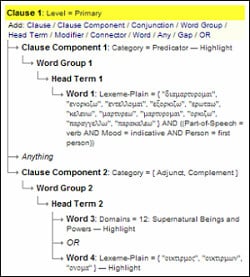
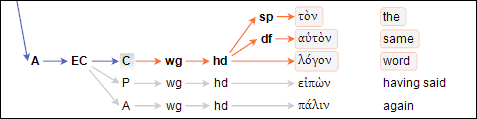
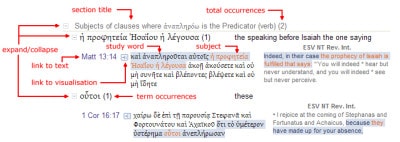
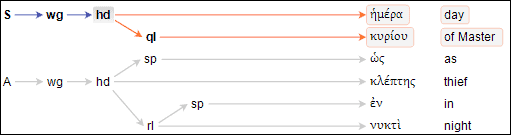
You didn’t know that you can just select a search template like “Subject”, fill in a blank, and find all the places where a particular Greek word (or, even better, English) is the subject of the clause?

Well, shame on me for not telling you earlier. But you can. Here’s how.

[Note: The Query Form feature is only available to users who have the Andersen-Forbes Hebrew Syntactic Analysis, the OpenText.org Greek NT Syntactic Analysis, and the Cascadia Syntax Graphs of the New Testament. The Andersen-Forbes and OpenText.org databases are in the Logos 4 Original Languages (LE) package and above; Cascadia is in the Logos 4 Scholar's Silver (LE) package and above.]

For other posts in this series, see:

Syntax Searching for Everyone: Grammatical Relationships

Video Tutorial

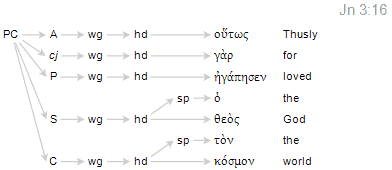
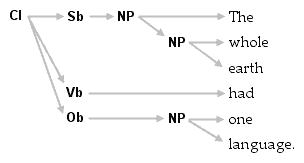
Syntax searching is one of the coolest features of Logos Bible Software 4. I mean, to search and find where something is the subject of a clause, or the object of a clause? So, where, say, Peter does something (subject) or where something is done to Peter (object)?

Despite its coolness, some people think that syntax searching in Logos 4 is difficult. And I’ll admit, understanding the intricacies of syntax databases, the theories behind them, and how they represent structures takes work. But you don’t need to actually devise a query to do a syntax search. There are multiple points of entry, and many do not require you to create a syntax query from scratch.

I recently put together a series of three videos titled “Syntax Searching for Everyone” to show how syntax searching can play a part in your study — without writing a query. As simple as a right-mouse click in a reverse interlinear Bible. The three videos are:

  • Syntax Searching for Everyone: Grammatical Relationships
  • Syntax Searching for Everyone: Using Query Forms
  • Syntax Searching for Everyone: Syntax Search Templates

Today’s video is Syntax Searching for Everyone: Grammatical Relationships. I hope it helps you in your study!

What About the Early Church?

Church Origins Collection (10 Vols.)
One of the areas of study that I’m most interested in, personally, is how the early church developed. That is, from the time of the apostles through around 300 AD, what happened? Who did what? And how did it affect the growth and development of the church? How did the Gospel disseminate?
There are a lot of books that fit into this space—it’s a popular place to be. But a useful collection you might not be aware of is the Church Origins Collection (10 Vols.) This is a set of 10 books that fit into the area of “Church Origins”. These books include:

  • Alexander J.M. Wedderburn, A History of the First Christians
  • Alan Kreider, ed., The Origins of Christendom in the West
  • Judith Lieu, Neither Jew Nor Greek? Constructing Early Christianity
  • Judith Lieu, Image and Reality: The Jews in the World of the Christians in the Second Century
  • Gerd Lüdemann, Primitive Christianity: A Survey of Recent Studies and Some New Proposals
  • Robert Murray, Symbols of Church and Kingdom: A Study in Early Syriac Tradition
  • Michael Brown, The Lord’s Prayer through North African Eyes: A Window into Early Christianity
  • Alastair Campbell, The Elders: Seniority within Earliest Christianity
  • Todd Penner, In Praise of Christian Origins: Stephen and the Hellenists in Lukan Apologetic Historiography
  • Thomas G. Weinandy and Daniel A. Keating, eds., The Theology of St. Cyril of Alexandria: A Critical Appreciation

I am deeply familiar with one of the books in this collection, Alastair Campbell’s The Elders: Seniority within Earliest Christianity. I picked this one up at the national SBL meeting one year and devoured it quickly. It is an excellent study of the concept of “Elder” as a title of honor, which morphed into an office in the early church. It surveys the Hebrew Bible, the LXX, the New Testament, and the letters of Ignatius to trace history and development of “Elders”. You might not agree with Campbell (I certainly don’t in all places) but it is an excellent look at this topic, across history. While you can purchase this book individually, it is spendy at $90, which is fully half of the collection price.
The other books I’ve not read in depth, but I am familiar with many of the authors. For example, Judith Lieu is responsible for two of the books in the Church Origins Collection: Neither Jew nor Greek?: Constructing Early Christianity and Image and Reality: The Jews in the World of the Christians in the Second Century. Lieu is well-known and well-regarded in the realm of study of earliest Christianity, particularly the not-so-clear area between Christianity and Judaism. Her work in this area is, from all I’ve understood, top-notch.
There are other familiar names, some you may know (Todd Penner, Alexander Wedderburn, Alan Kreider), some you may not (Michael Brown, Robert Murray) and some you may be predipsosed against (e.g. Gerd Lüdemann). Whatever your predisposition (now you know mine), each of these books provides a stimulating examination of their topic, and one’s understanding of the origin and development of the early church will likely be sharper for having read them.
If any of these sound interesting, chances are you’ll like most of the books in the collection. Check it out!

The Oxford Dictionary of the Christian Church

Oxford Dictionary of the Christian ChurchOne of the great benefits of the Logos 4 libraries is serendipity. Here specifically I’m thinking of finding books in your library that you didn’t really know you had, but once you find them you’re so glad you’ve got ‘em you don’t know how you studied without them.
For me, one of these wow-I’m-glad-I-found-it books is the Oxford Dictionary of the Christian Church (ODCC). It comes in the Scholar’s LE, Silver LE, Gold LE, Platinum LE and Portfolio LE libraries for Logos Bible Software.
And the ODCC is a gem. Clearly written. Top-notch scholarship. Recent. Relevant. Almost 2000 pages of excellent reference material that covers a wide array of topics and ideas. The ODCC is simply stunning.
One of my newfound roles here at Logos is that of columnist, where I’m responsible for the Thoughts from the Church Fathers column for Bible Study Magazine. As I work on each new column, the patristic entries in ODCC have been very helpful. They provide a great introductory sketch both of familiar figures (e.g. Augustine) and figures you might never have heard of (e.g. Cyril of Jerusalem). They lay out the contour and timeline while highlighting major issues, typically with links to entries describing these issues or debates. It’s like a one-stop shopping trip, and it is awesome.
But the patristic entries (while my favorite) are only one aspect of the ODCC. There is all sorts of stuff in it: Theology, Patristic scholarship, Churches and denominations, Church calendar and organization, Biographical entries, and more.
If you’ve got ODCC (just fire up Logos 4 and type ‘ODCC’ in the command box or in the Library to see if you have it already), then you owe it to yourself to check it out and look at some articles the next time you’re working on something (especially if you see any reference to particular church fathers).
If you don’t have ODCC, then you should check it out and, if the time is right, add it to your library. Or compare the cost of buying ODCC outright ($150 retail) with the cost to upgrade to at least Scholar’s LE. If your upgrade cost is close to (or under) $150, and you don’t have ODCC, then you could really end up getting a great deal on the upgrade — ODCC plus whatever else is in Scholar’s LE that you don’t already have.
Update: In the comments, it is noted that the 3rd edition of ODCC (from 1997) has been republished in paperback by another publisher. The edition in Logos Bible Software is the 2005 revision of the 3rd edition, which has some significant differences from the third edition. Below is an excerpt from the Note on the Revision of the Third Edition in the front matter of the 2005 edition:

The revision of the third edition was planned as a modest exercise, designed to incorporate changes which would not fit into successive reprintings and to include some updating wanted for a projected online version. The original pagination was to be preserved, and a limited number of short new articles were to come at the end. Until after production had been put in hand, I expected the pagination to be generally retained and I worked within this constraint. Nevertheless, the scope of the revision widened and I made a large number of small changes to reflect events and shifts in scholarly opinion over the last eight years or so, juggling with the text to fit in the new material. In some cases I commissioned completely new articles, impressing on their authors that they must be of the same length as the material they replaced. Inevitably, however, the main changes are in the bibliographies.

F. L. Cross and Elizabeth A. Livingstone, The Oxford Dictionary of the Christian Church (3rd ed. rev.; Oxford; New York: Oxford University Press, 2005), ix.

Zerwick’s Grammatical Analysis of the Greek New Testament

Many who use A Grammatical Analysis of the Greek New Testament in print affectionately refer to it as “Max & Mary” after the author and translator/reviser, Max Zerwick and Mary Grosvenor. The affection is for good reason, “Max & Mary” offer a helpful and informed analysis of the grammar of the Greek New Testament. And they do it in a commentary format, so the Logos Bible Software version (which you already have if you have the Portfolio LE edition of Logos) scrolls synchronously with your text — English (reverse interlinear? yes!), Greek, or whatever other New Testament edition you have.
I’ll be honest: I haven’t used this book much; it seems I have so many other tools available! But I’ve learned that I’m the one who has been missing out. Why? First, some minor points:

  1. There is a great little “Glossary of Grammatical Terms” included in the front matter.
  2. There are links throughout, by section number, to Zerwick’s Biblical Greek, Illustrated by Examples (included in the Introduction to Biblical Greek Collection)

I’ll use 1Ti 2.3-7 as an example of the kind of stuff that “Max & Mary” offer, listing the Greek text (NA27) with the Lexham English Bible translation interspersed. I’ve also highlighted in bold all of the terms that are mentioned. The analysis will follow for each verse, broken out with one item per line.

3 τοῦτο καλὸν καὶ ἀπόδεκτον ἐνώπιον τοῦ σωτῆρος ἡμῶν θεοῦ,
3 This is good and acceptable before God our Savior,

3 ἀπόδεκτος (< ἀποδέχομαι welcome) welcome, pleasing.
σωτήρ 1:1

4 ὃς πάντας ἀνθρώπους θέλει σωθῆναι καὶ εἰς ἐπίγνωσιν ἀληθείας ἐλθεῖν.
4 who wants all people to be saved and to come to a knowledge of the truth.

4 σωθῆναι aor. inf. pass. σῴζω.
ἐπί-γνωσις knowledge.
ἐλθεῖν aor2 inf. ἔρχομαι.

5 Εἷς γὰρ θεός, εἷς καὶ μεσίτης θεοῦ καὶ ἀνθρώπων, ἄνθρωπος Χριστὸς Ἰησοῦς,
5 For there is one God and one mediator between God and human beings, the man Christ Jesus,

5 εἷς…θεός there is one God.
μεσίτης mediator.

6 δοὺς ἑαυτὸν ἀντίλυτρον ὑπὲρ πάντων, τὸ μαρτύριον καιροῖς ἰδίοις.
6 who gave himself a ransom for all, the testimony at the proper time,

6 δούς aor2 ptc δίδωμι.
ἀντί-λυτρον ransom.
μαρτύριον evidence, testimony, i.e. to what has just been stated (v.4).
καιροῖς ἰδίοις at the proper time (time ordained by God).

7 εἰς ὃ ἐτέθην ἐγὼ κῆρυξ καὶ ἀπόστολος, ἀλήθειαν λέγω οὐ ψεύδομαι, διδάσκαλος ἐθνῶν ἐν πίστει καὶ ἀληθείᾳ.
7 for which I was appointed a herald and an apostle—I am speaking the truth, I am not lyinga teacher of the Gentiles in faith and truth.

7 εἰς ὅ to/for which.
ἐ-τέθην I was made, aor. pass. τίθημι appoint.
κῆρυξ -υκος ὁ herald, preacher.
ψεύδομαι lie, tell an untruth.
διδάσκαλος teacher.

Max Zerwick and Mary Grosvenor, A Grammatical Analysis of the Greek New Testament (Rome: Biblical Institute Press, 1974-), 629.

The analysis is rather compact and brief, but it gives helpful information, including potentially difficult bits of parsing/declension and glosses. These can help when reading or when thinking through a passage. Also helpful is the separation of prefix (typically prepositional) and root; this can help one recognize a word that might otherwise be unfamiliar. Lastly, they give some help for irregular forms (e.g. κῆρυξ -υκος ὁ in v. 7).
Max & Mary don’t just do this for a book of the NT, or a particular author; they do it for the whole Greek New Testament. That means that anywhere you go in the New Testament—any passage you’re studying—you can get some help from Max & Mary.
While I am impressed with the helpful analysis, I think I’m most impressed by a few paragraphs in the preface (quoted below in their entirety) that discuss the reason the work exists, and the people it is intended to help:

But most important of all is the purpose to be served. It is hoped that this English revised edition in its turn will mean that the Greek text of the New Testament will not remain exclusively a tool on the desks of a decreasing number of specialists but will become a living power in the hands of theologians, of preachers of the Word, of directors of Bible discussion-circles, and finally in the hands of those who pray in private from the Word of God. This is the purpose to be served. May God bless everyone helping it.

The student who has little knowledge of Greek should bear in mind while using this book that it is by no means necessary to understand immediately everything explained in it. The principle of one thing at a time will serve him well. Many of the linguistic subtleties go beyond the needs of the beginner and are intended for the more advanced student, interested perhaps in the characteristics of Hellenistic Greek as contrasted with classical Greek.

A helpful feature of this work (and a justification of its size) is the fact that a student can begin using it at whatever point he likes, each chapter being self-sufficient and not presupposing explanations given in the previous chapters.

Max Zerwick and Mary Grosvenor, A Grammatical Analysis of the Greek New Testament (Rome: Biblical Institute Press, 1974-), iii–iv.

Aquinas’ Catena Aurea: What’s the Big Deal?

The text of this post originated on the Logos Forums. It was written by Rosie Perera, who is a Logos MVP and has great insight on a wide array of topics and issues, both theological and technical. She’s also a friend of mine. Rosie has given me permission to reproduce her forum post here to try to bring some more attention to Community Pricing — a great way to get cheap books — and to highlight one of those presently very, very cheap books that may soon be a bit more expensive: Catena Aurea: Commentary on the Four Gospels by Thomas Aquinas (8 vols). Here’s Rosie:

Now that the George Müller collection is on its way, Catena Aurea is the next great buy in Community Pricing. With current bidding going as it has been, it looks like this gem will be available for $20 or less. We’re getting close to 80% of production cost.

Community Pricing is an awesome way to get works for the least expensive price imaginable. For example, the Müller collection went for $15 in community pricing, and pre-pub is now $79.95; sale price once it ships will be $129.95. And the nice hardback edition of Müller on Amazon.com costs $139.95.

Continue Reading…

Digging into the Church Fathers

The collection of writings known as the Early Church Fathers (37 vols) is included in Scholar’s Silver, Gold and Platinum collections, and also in Portfolio (LE editions).
That is a large collection. It’s great, and it is very handy to have indexed by reference and topic. I’ve personally benefited from it many times over the years. But it is tough to dig into and understand as a whole, particularly if you’re not familiar with the major writers. What to do?
One place to start out is H.B. Swete’s Patristic Study (sold separately; not included in base collections). This is a small book, but it gives an overview of people and themes in the first five centuries of the church. The product page gives a good description:

Patristic Study focuses almost exclusively on the Fathers of the first five Centuries. After reviewing these writers, Dr. Swete proceeds in the closing chapters to suggest methods of employing the work of the Fathers for the particular purposes of those in different lines of religious and theological study.

Swete’s book is handy to use as an less technical introduction to the writings of the Church Fathers found in the much larger Early Church Fathers (37 vols) collection.
What about other titles in this area? Logos has several available:

  • Getting to Know the Church Fathers; An Evangelical Introduction is a title on prepub (at the time this blog post was written). It distills information about the person instead of only the writings the person is responsible for. So figures in the early church like Augustine, Ignatius, Origen, Perpetua and Tertullian (and more) are described in ways that make their writings more accessible.
  • The Apostolic Fathers Greek-English Interlinear is also presently gathering interest as a prepub. Lexicons like BDAG, TDNT and TLNT (as well as several commentaries) cite the writings of the Apostolic Fathers all the time. If you don’t remember as much of your Greek as you’d like, or if you haven’t had a chance to take Greek yet, sometimes an interlinear can be helpful in tracking down these cross-references and examining word usages in context.
  • The New Testament in the Apostolic Fathers is a handy work that provides cross references between New Testament passages and writings of the Apostolic Fathers. This can be very handy.
  • Catena Aurea: Commentary on the Four Gospels by Thomas Aquinas is presently a community pricing title. This is less of Aquinas and more of a compilation of sentences/notes from the church fathers that end up functioning as a commentary — by the church fathers — on the Gospels. Fun stuff, might be worth checking out.

I’d better stop now — but can you tell I’m excited about this stuff? Logos has a goodly amount of titles available in this area (even a chunk of volumes from Patrologia Graeca on prepub!) so I’ll have to blog again about this in the future to point out some more stuff that you might be interested in.

Need Help with New Testament Exegesis?

A few years back, we published a series of seven books called Guides to New Testament Exegesis. The seven titles are also available individually (links below go to individual volumes), but of course you save by purchasing the collection:

These books provide a general introduction (by Scot McKnight, no less!) to the interpretation of the New Testament, as well as genre-specific methods and materials for doing exegesis. One thing I didn’t know (but learned from reading the product page on Logos.com — good stuff there!) was that:

The vision for this collection comes from Gordon Fee’s New Testament Exegesis: A Handbook for Students and Pastors. By developing handbooks for each genre and book collection, this collection operates as an extended treatment of Fee’s narrower scope.

Fee’s work is detailed and valuable; to have his methodology distilled and applied to these particular genres is a helpful thing. It’s like getting a jump start in New Testament exegesis. And to have it done by folks of the caliber of Scot McKnight, Thomas Schreiner, and Gary Burge? Even better. Check it out.

Speaking of New Testament exegesis, another title that you might find helpful is Donald Hagner’s introduction, New Testament Exegesis and Research: A Guide for Seminarians. This is geared toward seminarians, but helpful for everyone. If I understand correctly how the book came about, it is basically the information that Hagner gives incoming seminarians, to get them properly grounded at the start of their seminary career.

Need some more suggestions? I’m out of room here, but you might try I. Howard Marshall’s New Testament Interpretation, David Alan Black’s Interpreting the New Testament, or perhaps even Katharine Barnwell’s Linguistics and New Testament Interpretation. Check ‘em out!

Moulton & Milligan’s Vocabulary of the Greek Testament

Do you find yourself living in a Greek lexicon as you work through the text of the New Testament?
Do you do look for the lexicon to tell you more about how a word is used, and the different contexts in which the word is used?
If you do, chances are you have already invested in what many consider to be the best lexicon for New Testament Greek, BDAG. And chances are that you love it.
Did you know that there is another Greek lexicon, focused on words that are used in the New Testament, that largely complements BDAG?
It is called The Vocabulary of the Greek Testament, put together by James H. Moulton and George Milligan in the early 1900′s.
Now, “The Vocabulary of the Greek Testament” is not a great name because it doesn’t just sound like a lexicon. But it is. And it isn’t a lexicon like BDAG is a lexicon. That is, it doesn’t re-plow the same field of sources (New Testament, LXX, Apostolic Fathers, Josephus, Philo, Greek Pseudepigrapha, etc.) that BDAG and other Greek NT lexica do; instead Moulton and Milligan (hereafter M-M, which is the way BDAG cites it) plow through the ground of the hordes of papyri that were found in the late 1800′s and early 1900′s, focused on papyri usage of vocabulary items that occur in the Greek New Testament (hence the “Vocabulary” name). They’re looking for insight from how these under-utilized papyri use the same words found in the Greek New Testament.
That’s why M-M is largely complementary to BDAG. They aren’t examining the same sources; they’re examining altogether different uses of the same words. And it is M-M‘s insight, from these scads of papyri that have been found and analyzed, that complements BDAG so well — in fact, so well, that BDAG routinely refers the reader to M-M where M-M has pertinent information. What kind of information? Here’s an example that Milligan uses in his introduction:

In what are probably the earliest of his letters that have come down to us, the two Epistles to the Thessalonians, St. Paul finds it necessary to rebuke his converts for walking “in a disorderly manner” (2 Thess 3:11). The word (ἀτάκτως), with its cognates, is confined to these Epistles in the New Testament, and what exactly is meant by it is by no means clear at first sight. Is St. Paul referring to actual sin or moral disorder, or to something less heinous? The papyri have supplied the answer in a striking manner. Among them is a contract of A.D. 66 [P.Oxy.II 275] in which a father arranges to apprentice his son with a weaver for one year. All the conditions of the contract as regards food and clothing are carefully laid down. Then follows the passage which specially interests us. If there are any days during this period on which the boy “fails to attend” or “plays truant” (ὅσας δʼ ἐάν ἐν τούτω ἀτακτήση ἡμέρας), the father has to produce him for an equivalent number of days after the period is over. And the verb which is used to denote playing truant is the same verb which St. Paul uses in connexion with the Thessalonians. This then was their fault. They were idling, playing truant. The Parousia of the Lord seemed to them to be so close at hand that it was unnecessary for them to interest themselves in anything else. Why go to their daily work in the morning, when before night Christ might come, they thought, forgetting that the best way to prepare for that coming was to show themselves active and diligent in the discharge of their daily work and duty.

If you don’t have The Vocabulary of the Greek Testament in your Logos Bible Software library yet (and it presently isn’t in any packages, not even Portfolio) you might want to consider adding it today.

Page 4 of 22« First...«23456»1020...Last »